Aquafa Salt Mine Massacre
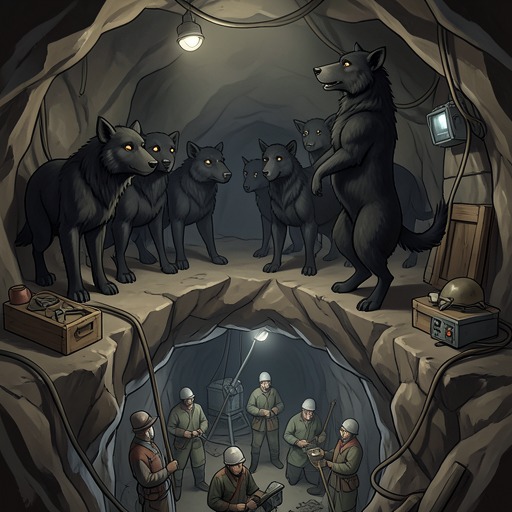
The Deer KingThe Aquafa Salt Mine Massacre is the slaughter of the people inside the salt mine by a pack of deliberate, coordinated beasts. Van was the sole survivor identified in the account, and the attack connected an atrocity at the mine to a continuing mystery: the beasts were being driven by someone, while Van felt a startling familiarity when he met one in the darkness. His survival later made him a potential source of blood for a serum, and his life in Oki carried the massacre’s consequences into the intimate work of caring for animals and building relationships.
The Attack and Its Survivor
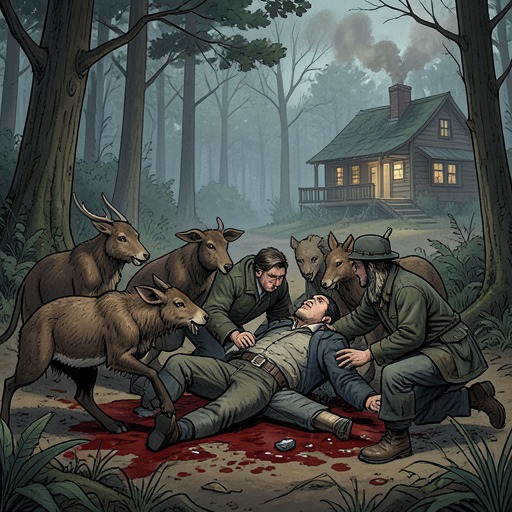
In daylight, looking at a carcass after another encounter with the creatures, Van recognized one of the beasts that had attacked the salt mine and slaughtered everyone inside. He remembered their strangely luminous eyes and the purposeful way they had bitten their victims one by one. The method had made him think of soldiers; what he now saw confirmed that the attackers were not simply wild animals acting on instinct.
Van understood that the creature had moved with a pack under the direction of a person who had some purpose of their own. This recognition changed the massacre from an inexplicable animal assault into evidence of organized control, though the person directing the beasts remained unidentified in the supplied account. The revelation did not resolve Van’s own reaction: what stayed with him most vividly was a warm, almost nostalgic bond that had seized him when their eyes met in the darkness, rather than fear or regret.
Survival and the Search for Van
Van’s survival made him central to Hohsalle’s investigation. Speaking with the director, Hohsalle recalled that one man had survived the tragedy at the Aquafa salt mine: Van, from the Toga Mountains. He considered finding him worthwhile because a sample of Van’s blood could offer a chance to produce a highly effective serum. The massacre therefore became not only a past catastrophe but also a possible source of medical knowledge.
After the mine attack, Makokan followed Van’s trail to Oki with a Molfah tracker, but they did not find him. Hohsalle later recounted the failed search as an episode already familiar to the people listening. The account establishes both the effort to locate the survivor and its failure; it does not say that Van’s blood was obtained or that the serum was produced.
The Survivor’s Life in Oki
Van’s later life in Oki was bound to pyuika, whose behavior he understood through the practical knowledge of his mountain upbringing. Pyuika formed lasting attachments: once bonded, they remembered their companions and could become lonely when separated. Tsupi’s habit of nudging Van had been a sign that she was attached to him. Far from her home and without other pyuika in the woods, she would ordinarily have returned when the scent of an ossam faded. But it was fall, mating season, and Van believed that a bull elk’s scent had put her in heat and drawn her into the forest. Tracking her meant reading hoofmarks and the urine frightened pyuika left behind.
That knowledge also gave Van a way to interpret the animals’ captivity. Mohoki, a lichen growing on old trees, repelled pyuika; dried strands woven into ropes around a fence could keep them penned. Without it, they might jump out or decline in an enclosure. Yet confinement was not a good substitute for their roaming habits. Herds were broad and loosely organized, with the doe and her fawns forming the clearest unit; animals migrated seasonally along habitual routes, and planting mohoki strategically could influence where they traveled. The people from Okuba who sold pyuika to Yoki had apparently known of mohoki, but Yoki had not.
Van’s approach to raising the animals was to let them range freely and cultivate familiarity with people, rather than treat them as ordinary livestock. He had persuaded the men to let the pyuika roam in spring despite their fear that the animals would not return. Pyuika traveled a narrower range than deer, and boys who grew up among the herds learned to predict their movements by watching them in the forest. Wild pyuika resisted people after reaching maturity, but an animal exposed to a person’s scent from birth could form a bond that endured for life.
Breeding, Migration, and Shared Work
Pyuika reproduction and migration made herd-keeping a seasonal negotiation rather than a simple matter of enclosure. The animals always bore twins; Van remembered his father’s rule for choosing a fawn to raise among people: “The weak one to the mother, the strong one to me.” The larger twin, which drank more milk, was separated and accustomed to humans. Van’s family knowledge thus depended on a consequential choice made at the beginning of an animal’s life, not merely on later training.
The reindeer’s summer migration coincided with the pyuika calving season. The previous year, the pyuika had produced no young, and Ohma explained that the people had simply hitched them to ropes and led them along after the reindeer. Van suspected that forcing them to follow this unnatural schedule had contributed to their failure to breed. But the reindeer also had to leave their winter pastures: summer brought horseflies and mosquitoes, the grasses there were thin, and the animals needed sea-wind-swept pastures where pests were less troublesome.
The family’s solution was to enlist neighboring Zolian immigrant families who also wanted to breed pyuika. Three of Kiya’s nephews—Mino, Chida, and Moki—stayed with Van and Tohma to learn their care, while the others took the reindeer to the usual summer pasture. Kiya stayed behind to look after Yuna. Van was grateful for that help, but he could not suppress his loathing at the sight of Kiya’s nephews: their appearance recalled enemies he had faced on battlefields. They, in turn, were intimidated by him and followed him through the forest in grim silence. The shared work created an uneasy but practical alliance, with Van’s expertise drawing people together even as the violence of his past obstructed trust.
Aftermath and Significance
The massacre’s consequences persisted through Van’s involuntary recognition of the beasts and the search for his blood, but the narrative also places his survival within the demands of ordinary care. In winter, he gathered ashimi, a green lichen that pyuika ate heavily in mating season and seemed to crave when bearing young. It grew fresh beneath frost, but collecting it required slogging through deep snow and digging it out so that does might bear strong calves. Tsupi butted and nuzzled Van as he set down a bundle for her, a small, reciprocal sign of the attachments that his expertise depended on.
Van could find ashimi by smell, a capacity he had not previously recognized. Its scent both attracted and repelled him, and it stirred memories of the night the rochai came. The lichen’s practical value for breeding thus sat beside its disturbing association with the attack. Across these details, the massacre remains more than a single episode of slaughter: it shadows Van’s encounters with the controlled pack, offers Hohsalle a possible route toward treatment, and alters the emotional texture of the landscape in which Van tries to build a future.